Case study · Interface · Audio
Modernising an icon: Marantz’s porthole, now a display.
The round porthole has been Marantz’s brand signature for seven decades. For the Model 10 flagship amplifier, Sound United briefed us to turn that porthole into a high-resolution, audio-reactive display — without losing a gram of its analog soul.
The challenge
Marantz amplifiers have carried the round porthole since 1953 — it is one of the few visual signatures that hi-fi collectors recognise across generations. The business tension was simple: the porthole was analog, the competitive landscape (NAD, Naim, Cambridge Audio) had moved to higher-resolution branded GUIs, and Marantz needed a next-generation flagship that spoke to a buyer who grew up on retina displays but still wants the amp to feel like a serious instrument.
Sound United’s ID-UX group needed a prototype that would prove the display could carry Marantz’s brand language in a modern, GPU-driven medium — and then a path to put that prototype on the shelf as the Model 10’s actual front panel.
Our approach
We organised the work in four phases spanning ten months: Analyse → Conceptualise → Visualise → Prototype → Integrate. The Analyse phase mapped competitor display approaches and audited what Marantz’s brand language needed from a display medium. Conceptualise locked the porthole-as-display premise with the industrial design team. Visualise built the motion-rich GUI in TouchDesigner. Prototype rebuilt it in Qt against the HEOS platform. Integrate handed it to the Model 10 product team as production-ready specs.
Three design decisions carried through all four phases:
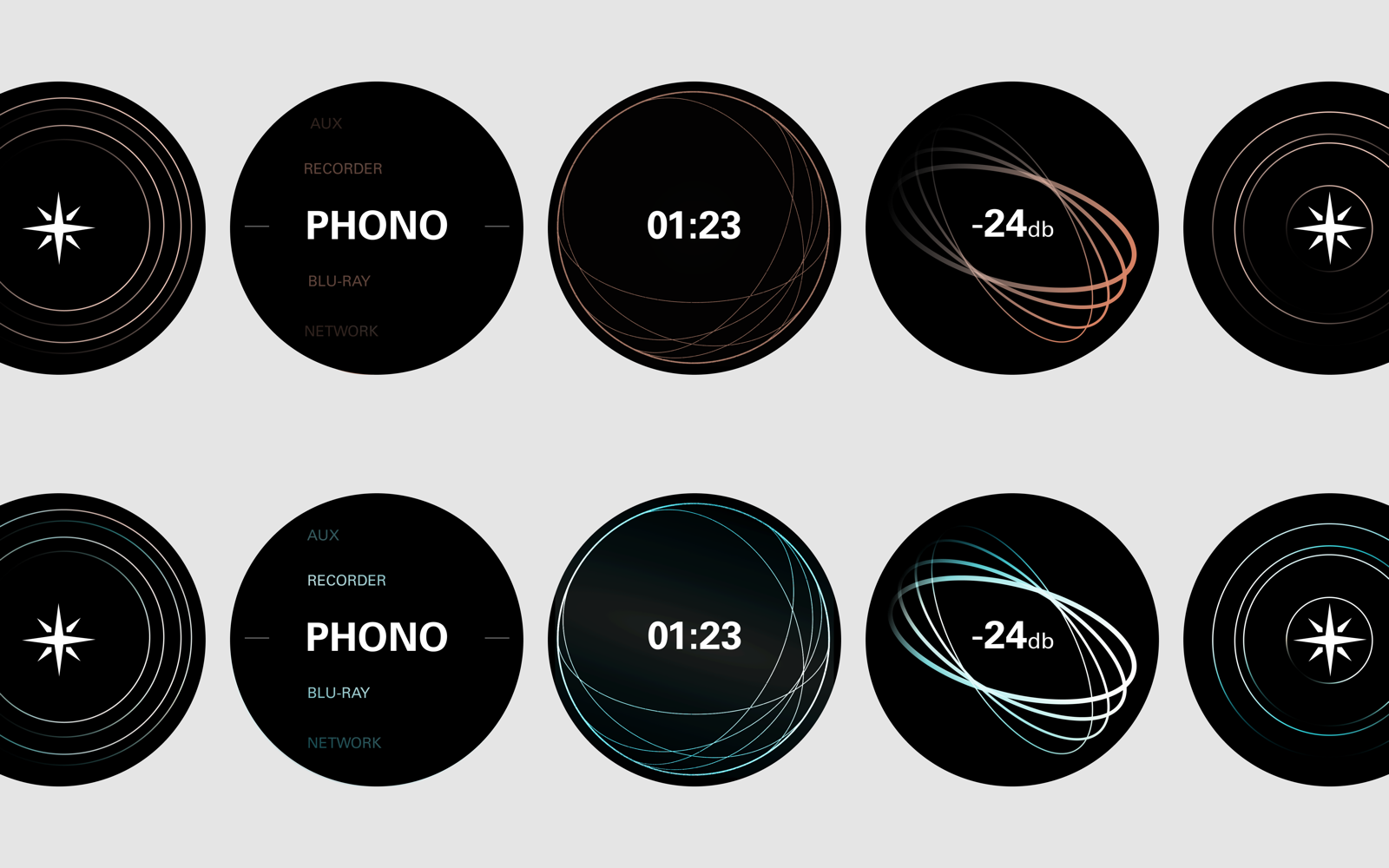
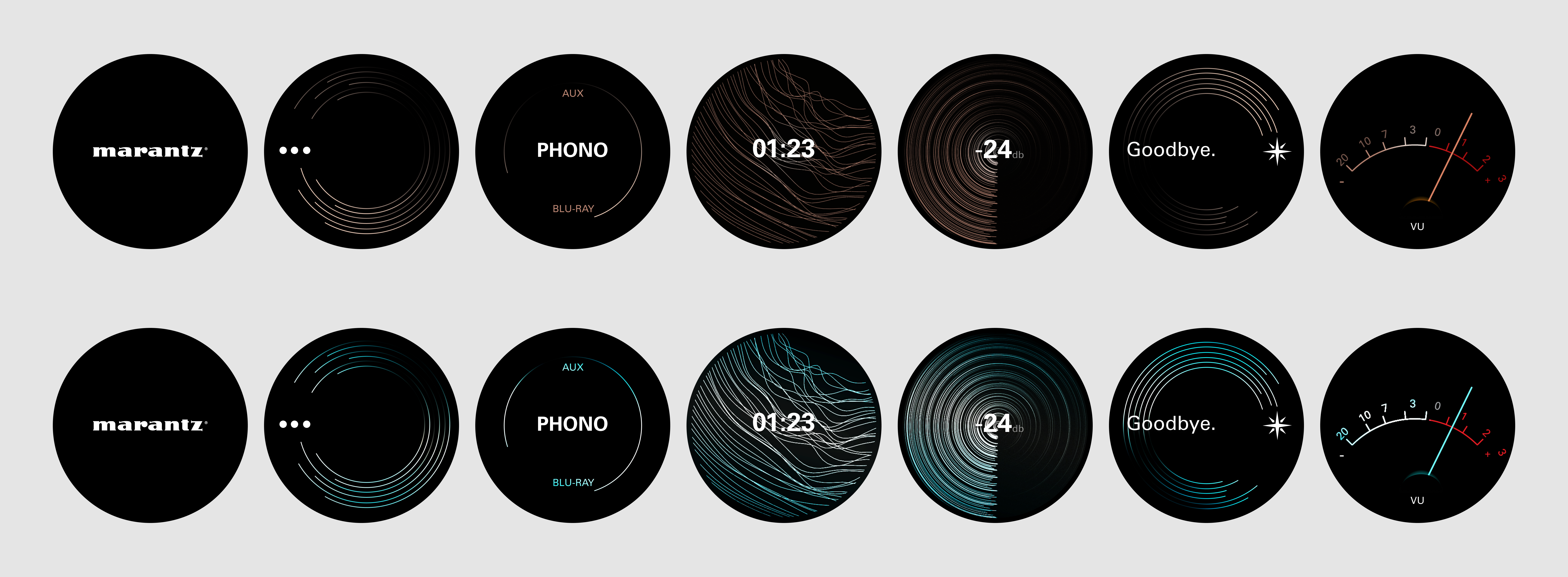
- The porthole stays a window, not a screen. Interactions are centred, radial, one-at-a-time — source, volume, metering, farewell. Each state fills the circle; nothing competes.
- Audio-reactive, not loud. Spectrum motion appears when the music calls for it (track change, phono start, VU peaks), then recedes. The display breathes with the music instead of narrating it.
- Analog feel, digital expression. Edge geometry, type weight, warm-amber accent, slow transition curves — all drawn from the Marantz heritage palette and remapped onto a 1:1 round GPU surface.
What shipped
The prototype delivered seven canonical porthole states — brand mark, source, time, volume, VU meter, spectrum, farewell — in two chromatic variants so the industrial design team could choose their palette direction. The underlying GUI library was built in Qt against the HEOS-as-Platform vision, which meant the same display pipeline could extend to future Marantz and Denon products without a rebuild.
The Model 10 shipped with the Porthole display as its signature front-panel element. The design language we established — centred radial geometry, audio-reactive motion, warm-amber accent — now informs the broader Marantz hi-fi line.
Underneath the visible display sits the iceberg: the Qt-HEOS module, JSON-defined animations, IR remote command mapping, and the microcontroller glue that lets a prototype become a product. We designed and specified that whole stack, not just the surface.
Awards & recognition
The Model 10 was recognised as a new reference in high-end amplifier design the year it launched:
- EISA High-End Integrated Amplifier 2025–2026 — the European Imaging and Sound Association called the Model 10 “setting a new benchmark”
- iF Design Award — for the industrial and interface design of the Model 10
- SoundStage! Network Product of the Year 2025
What it moved — Denon + Marantz
The Porthole work was part of a broader UX direction across the Sound United / D&M Holdings portfolio. Over the same window, the Denon side of the house saw its sound-bar and AVR categories climb hard in Japan:
- Denon DHT-S217(K), a Dolby Atmos soundbar, held #1 Japan home-theatre sales for six consecutive weeks from January 2023 (BCN retail data), and remained the best-selling home-theatre system in Japan through 2024.
- Across the Denon soundbar + AVR portfolio, D&M Holdings captured over 70% of Japan’s home-theatre market with just two SKUs.
- Marantz’s Model 10 anchored the hi-fi flank with the awards above — a reference tier that pulls the whole brand up with it.
Awards get published; market share compounds. Both landed inside the same UX direction era, and the Porthole design language is now the throughline between the flagship amplifier and the soundbar lineup underneath it.
What we did
- Lead UX for the ID-UX prototype across four phases (Analyse → Integrate)
- Competitive display landscape analysis (NAD, Naim, Cambridge Audio)
- Motion-rich GUI concept in TouchDesigner, then Qt production rebuild
- Audio-reactive visual programming & hardware interaction prototype
- Specialist-team orchestration — motion/interaction (ex-Nokia, ex-Shazam) + TouchDesigner front-end + Qt engineering
- Bilingual EN/JA display tokens for the Japanese audio market
- Prototype-to-production handoff with the Model 10 product team
“The porthole stays a window, not a screen.”
design principle · Model 10 Porthole proposal
Credits & collaborators
- Lead UX
- Keisuke Shingu · Milieu Creative
- Sound United ID-UX
- Industrial design partners inside the Sound United product team
- Motion & interaction design
- Andy Ellis — previously Nokia, Shazam
- Front-end prototype (TouchDesigner)
- Jarret Smith — co-founder, TouchDesigner studio
- Qt engineering
- Qt Group embedded platform team
- Product integration
- Marantz Model 10 product & HEOS platform teams